
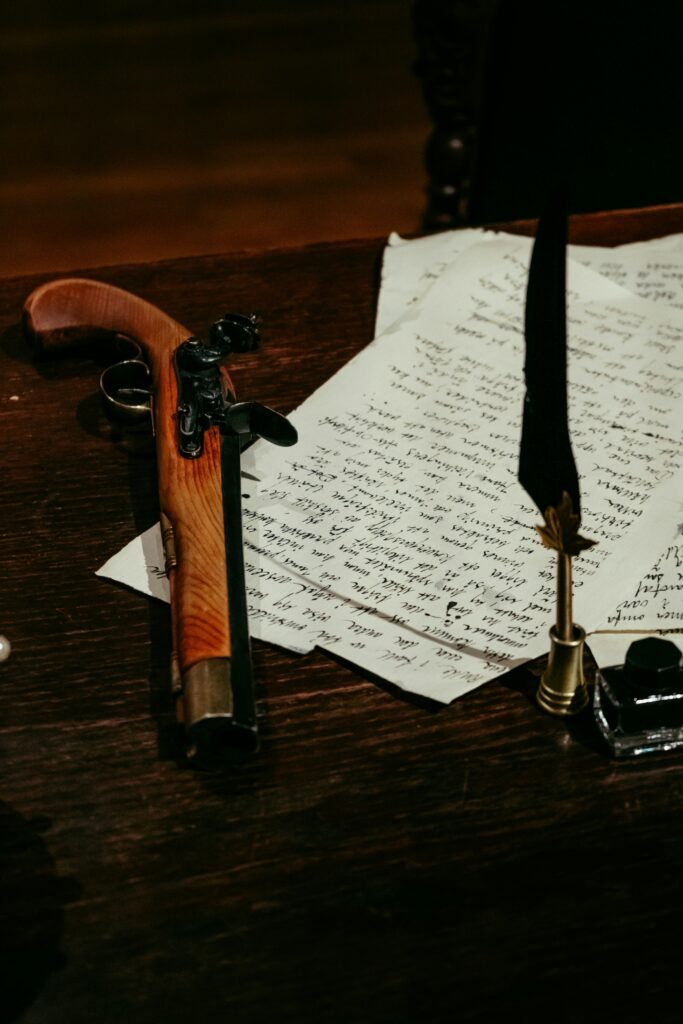
Philadelphia smelled of rain and ink. In a narrow shop on Market Street, a young printer bent over his press, sleeves rolled, fingers black with ink. Benjamin Franklin had learned as a boy that words can warm a cold room; now he meant to prove they could steady a nation. He set type the slow way—letter by letter—because truth deserved a careful hand.
Franklin printed for usefulness and for conscience. Poor Richard’s Almanack braided wit and wisdom into something ordinary people could carry in a pocket and live by at supper: do the next right thing; keep faith with your neighbor; let your deeds speak. But his greatest invention was not a phrase—it was a public good. In 1731, with a small circle of tradesmen and friends he called the Junto, he founded the Library Company of Philadelphia: a shared shelf of books that anyone could borrow. That simple, generous idea—knowledge held in common—became the pattern for public libraries across America. A people who could read together might one day govern themselves together.
Across the ocean, a restless Englishman felt the pull of that light. Franklin met Thomas Paine in London in 1774 and urged him west with letters of introduction and, more importantly, permission to believe his pen could matter. Two winters later, in a city braced by wind and argument, Paine published Common Sense—forty-seven pages printed for the common ear. Farmers read it aloud in taverns. Mothers copied lines by lamplight. Soldiers tucked it into their coats. On a bleak December night, Washington had it read to his men before they crossed the Delaware.
Paine’s gift was moral plain-speech. He said out loud what courage had been whispering: liberty is not a favor from rulers; it is a duty we owe one another. When the war darkened, he refused to dim his ink. Across seven years he issued The American Crisis in sixteen installments, each a pulse of resolve sent to a weary people. “These are the times that try men’s souls,” he began—and men who had almost given up found themselves standing again.
Something irreversible happened then. The press ceased to be merely a trade and became a trust. Words stopped decorating life and began directing it. The republic did not begin with a signature; it began with sentences—set in lead, read aloud, believed together. Printers risked prison for treason. Readers risked their lives for ideas. Freedom took the shape of paragraphs before it wore the clothes of law.
When the muskets finally quieted, Franklin’s counsel softened toward peace. He returned to the slow work—schools, libraries, neighborliness. He reminded anyone who would listen that liberty survives only where honesty and curiosity are kept in repair. Enlightenment, to him, was not a chapter of history but the daily habit of seeking light.
The flame he kindled and Paine fanned did not go out. It traveled from broadsides to schoolrooms, from street corners to kitchen tables, from declarations shouted to promises kept. The medium changed—paper to radio to screen—but the calling did not: to tell the truth with grace; to lift the young without forgetting the old; to bind communities with stories sturdy enough to hold.
That calling lives where it always has—in the hands of ordinary people who choose decency over noise. It lives when a parent reads aloud, when a teacher passes a page with care, when a small business uses its voice to serve rather than to shout. It lives when a magazine remembers that families are not an audience to be harvested but a people to be helped.
We stand in that current. Not as curators of nostalgia, but as keepers of a living trust. The same lamp that lit a print room on Market Street still throws its circle of warmth across kitchen tables in Minnesota. We publish for that circle—for the neighbor who needs courage tonight, for the child who deserves a gentler world tomorrow.
If a sentence can steady a hand, if a story can open a door, if a page can make someone kinder, then the republic of words endures. Not as a slogan, but as a daily choice: to make what we print worthy of the souls who read it.
The tools have changed. The charge has not. We will borrow Franklin’s patience and Paine’s fire, and we will use them where they matter most—at home, in community, for the good of one another. And if some future reader finds in these pages a reason to stand, to serve, to hope—then the light has done what light always does.
It has found another pair of hands.